Article: A collection of Balucharis from the 19th century unlike any others
A collection of Balucharis from the 19th century unlike any others
Over the years, we at the The Far East Art Studio have evolved into a research-based textile studio with a keen focus on studying, documenting and making textiles based on the design language of the 18th and 19th century.
As a small team we focus on a few textile traditions at any time with an endeavour to learn in depth about these textiles. For the last six years one of our focus has been Balucharis from the 19th century.
We have had the chance to see some of the spectacular Balucharis in museums and private collections all over the world. In this newsletter we share snippets of some Balucharis which look to have been created as a collection were they have close resemblance with each other but they are distinct in their design.
They are unlike any Balucharis that we generally see.

The V&A Museum, London : A 19th century Baluchari Saree of woven silk which is brocaded with a repeated floral motif in green and cream silk; palla with a row of stylised flowers, and borders, in green and cream silk
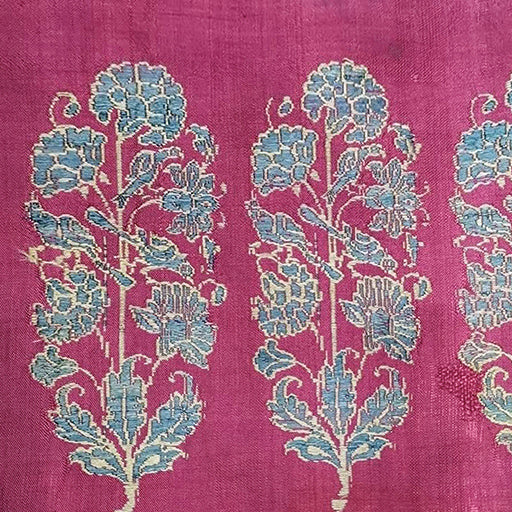
Unlike the popular notion of Balucharis featuring Mahabharatas & Ramayanas, the 19th century which flourished under the patronage of the Nawabs often featured court scenes or Englishmen and Nawabs in what we now popularly call the Nawabi Balucharis. But there is a whole collection of them featuring paisleys resembling Mughal flowers. They are believed to be influenced by Ashawalis. As seen in the saree from the Victoria and Albert Museum in London, these sarees have a very distinctive border, the style of the pallas are similar and they almost always feature a bunch of flowers - each one different from the other.

|
The Metropolitan Museum of Art, New York: A 19th century Saree, woven with silk and metal threads |
The Metropolitan Museum of Art in New York has a very similar saree to the other Balucharis that we have seen. The colour is distinctly different and the butas in the palla are are divided into three section by the use of different shades of colours.
While most Balucharis are in shades of purple and red, this particular saree might have been commissioned to the weaver.

The Indian Museum: 19th century Baluchari Saree, woven in red silk
The Indian Museum in Kolkata houses some of the most unique Balucharis. Also seen there is one saree from this group of Balucharis. While it looks to be identical to the one at the Victoria and Albert Museum in London, a close inspection shows flowers and peacocks in the palla motifs.
We hadn't taken a closer photo of this saree, but we would highly recommend a visit to the museum to see some of the best textiles from the Indian subcontinent.

If we hadn't worked so closely with Balucharis, we would not had a chance to come across such unique Balucharis. We came across a Baluchari from the same collection with an antique textile collector in India.
This particular one also looks identical to the one at the Victoria and Albert Museum but it actually features birds and flowers. The artistry of the sarees always leave us spellbound.

Any discussion of the 19th century Balucharis cannot be complete without the mention of the Tapi Collection of Praful and Shilpa Shah. Seen above is a Baluchari from the same collection of sarees. The beauty of this saree lies in it's simplicity.
We have used some of these sarees as inspirations in our collection. If you have an old Baluchari or an Benarasi that you would like to make, please do write to us at tfeas.india@gmail.com. We would love to hear from you.